
Roof systems · Coating systems
Silicone, Acrylic and SPF Roof Coatings: How the Chemistries Differ
Holding two coating bids with different chemistries? Here's how they differ and what the code asks of them.
- Free roof condition report: repair, coat or replace?
- Good, better and best options
- Certificate of insurance within 24 hours of request
The main coating chemistries
- Acrylic: a water-based elastomeric coating. Minimum performance spec: ASTM D6083.
- Silicone: an elastomeric silicone coating. Minimum performance spec: ASTM D6694.
- SPF (spray polyurethane foam): foam insulation and roofing in one layer, protected by an elastomeric top coat. Foam spec: ASTM D7425.
Other chemistries, such as urethane, exist too. Whether your roof should be coated at all is a separate question; see roof restoration and coatings.
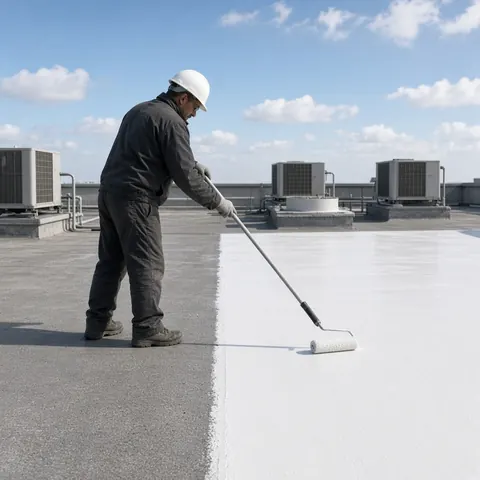
Illustrative image, not a completed project.
Silicone vs. acrylic on a Bay Area flat roof
- Ponding: manufacturers commonly market silicone for roofs that hold water, while many acrylic data sheets exclude ponding areas. Check the data sheet for the product you're being offered.
- Cure and rain: water-based acrylics need dry, mild weather to cure, and their data sheets give temperature, humidity and rain-free windows. At the NOAA stations we checked across the region, most of the year's rain falls November through March (NCEI, 1991–2020 normals), so schedule acrylic work outside those months.
- Recoating later: manufacturers generally say new silicone adheres best to existing silicone. Ask for the manufacturer's recoat procedure before you choose.
SPF foam roofs
Spray polyurethane foam is sprayed onto the deck or the old roof, where it expands into a seamless layer, then gets an elastomeric top coat. UV breaks down exposed foam, so the top coat is what protects it, and keeping that coat maintained is the job (manufacturer guidance).
Where coatings fail
Poor adhesion
Dirty or incompatible surfaces.
Wet insulation underneath
A coating seals the moisture in.
Thin application
Less than the manufacturer's specified thickness.
Wrong chemistry for ponding
A coating not listed for standing water.
Details skipped
Seams and penetrations not reinforced before coating.
Coatings and Title 24
Recoating counts. On nonresidential low-slope roofs where more than 50% of the roof area or more than 2,000 square feet, whichever is less (Energy Code §141.0(b)2B) is replaced, recovered or recoated, the surface needs aged solar reflectance of at least 0.63 and thermal emittance of at least 0.75, or an SRI of at least 75, with a CRRC label (§140.3(a)1A; CEC 2025 Nonresidential Cool Roofs FAQ). Our Title 24 re-roof guide walks through the trigger, the cool roof values and the insulation rule.
- Aged ratings: if a coating has no CRRC aged value, the code estimates it from the initial value as 0.2 + β(initial − 0.2), with β = 0.65 for field-applied coatings (CEC FAQ). Check the product's CRRC listing.
- Field-applied coating rules (§110.8(i)4): the coating goes over the entire roof surface at the manufacturer's specified dry mil thickness or coverage, and meets the minimum performance requirements of Table 110.8-C or the applicable ASTM standard (C836, D3468, D6083 or D6694). Exceptions exist for aluminum-pigmented asphalt and cement-based coatings (CEC 2025 Standards; Energy Code Ace).
- Insulation: a full recoat is exempt from the insulation requirement (CEC FAQ); a replacement over conditioned space isn't.
- Wildfire areas: in wildland-urban interface areas, coatings aren't an approved method of roof fire protection, and a Class A roof is required (California Wildland-Urban Interface Code 503.2.5). See Santa Cruz County.
Acrylic vs. silicone vs. SPF
| Acrylic | Silicone | SPF + top coat | |
|---|---|---|---|
| ASTM spec | D6083 | D6694 | D7425 (foam) |
| Base | Water-based | Silicone | Sprayed foam with an elastomeric coat |
| Ponding water | Many data sheets exclude it | Commonly marketed for it | Depends on the top coat |
| Goes over | Substrates the manufacturer lists | Substrates the manufacturer lists | Deck or existing roof, per the manufacturer |
| Cool-roof check | CRRC listing | CRRC listing | Top coat's CRRC listing |
Where we work
Commercial, industrial, multifamily and HOA roofing across six Bay Area counties.
- Santa Clara County, CASan Jose, Santa Clara, Sunnyvale, Mountain View, Palo Alto, Milpitas
- San Francisco County, CASan Francisco
- San Mateo County, CARedwood City, San Mateo, South San Francisco, Burlingame, Foster City
- Alameda County, CAOakland, Fremont, Hayward, Newark, Pleasanton, Berkeley
Frequently Asked Questions
It depends on drainage. Manufacturers commonly market silicone for roofs that hold water, while many acrylic data sheets exclude ponding areas. Acrylics are water-based and need dry, mild weather to cure, so schedule them outside the November to March rains. Either must be CRRC-rated for a qualifying re-roof.
Yes, on nonresidential low-slope roofs when more than half the roof or more than 2,000 square feet, whichever is less, is recoated. The coating must be CRRC-rated with at least 0.63 aged reflectance and 0.75 emittance, or SRI 75, and applied over the whole roof at the manufacturer's specified thickness.
Spray polyurethane foam is sprayed onto the roof deck or old roof, where it expands into a seamless insulating layer, then gets an elastomeric top coat to protect it from UV. The foam is specified under ASTM D7425. Keeping the top coat maintained is what protects the foam underneath.
Look up the product in the Cool Roof Rating Council's directory for its aged solar reflectance and thermal emittance. If no aged value exists, California's Energy Code estimates it from the initial value using a formula that discounts field-applied coatings more than factory products.
Not as the roof's fire protection. California's Wildland-Urban Interface Code doesn't accept coatings as an approved method, and WUI areas require a Class A roof assembly. Before coating a roof in a WUI area, ask the manufacturer whether the assembly keeps its Class A listing.
Let's get started
Is my roof a coating candidate?
Tell us the property, the roof type and what you've been offered. For an active leak, call.
- (408) 770-5992Calling is fastest for an active leak