
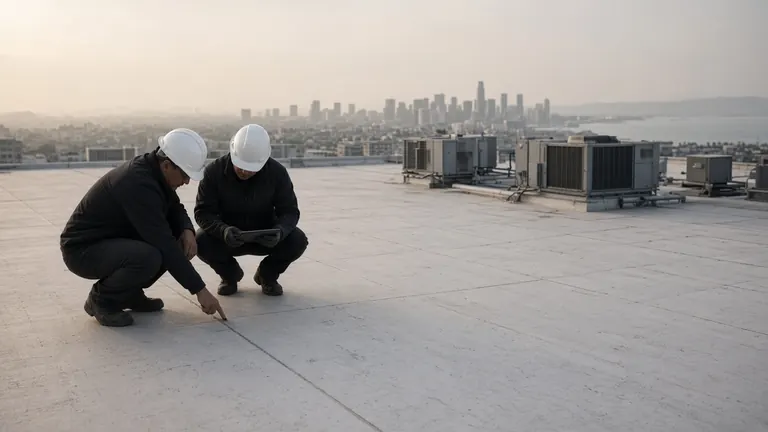
City of Santa Clara · Santa Clara County
Commercial Roofing in the City of Santa Clara: Tilt-Ups, R&D and Equipment-Heavy Roofs
Roofs on tilt-up, R&D, office and HOA buildings in the city of Santa Clara. Elsewhere in the county? See Santa Clara County.
- Free roof condition report
- Good, better and best bid options
- Certificate of insurance within 24 hours of request
A city of tilt-ups and R&D buildings
Kidder Mathews counts 13.0 million square feet of R&D in Santa Clara, with about 687,000 square feet under construction and 9.2% total vacancy (Silicon Valley R&D, Q3 2026). Much of it is concrete tilt-up and flex from the 1960s through the 1980s.
R&D and flex buildings often carry dense rooftop mechanical equipment and many penetrations, so work planning, protection and documentation matter as much as speed.
Housing: the California Department of Finance counts 26,888 units in 5+ unit buildings and 5,213 single-attached units, in a city of 138,011 (January 1, 2026).
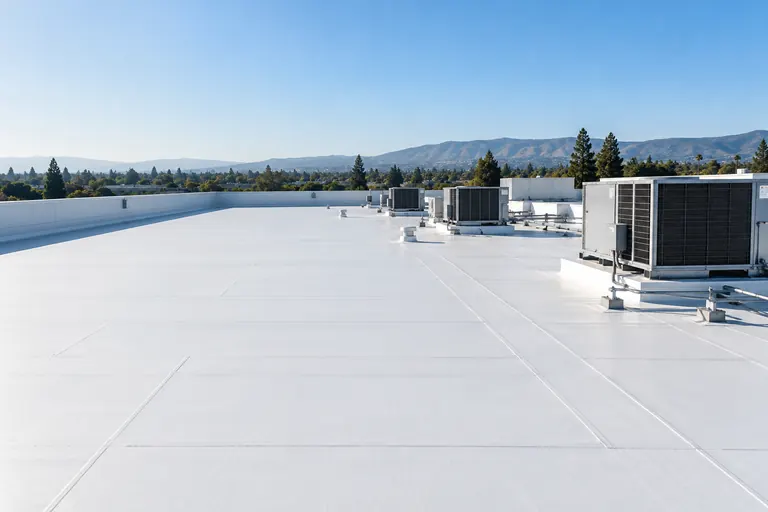
Illustrative image, not a completed project.
Title 24 on mixed buildings: offices, warehouses and process space
The Santa Clara ZIPs we checked (95050, 95054) are in climate zone 4 (CEC ZIP list). A qualifying nonresidential low-slope re-roof needs aged solar reflectance of at least 0.63 and thermal emittance of at least 0.75, or an SRI of at least 75, with a CRRC label (CEC; BayREN). The size threshold is more than 50% of the roof area or more than 2,000 square feet, whichever is less (Energy Code §141.0(b)2B). Our Title 24 re-roof guide walks through the trigger, the cool roof values and the insulation rule.
Measured in sections
BayREN's checklist says roof area over unconditioned space, such as a warehouse, or process space, such as manufacturing, isn't counted when checking the size threshold, and the continuous-insulation requirement (R-23 in climate zone 4) applies only over conditioned or indirectly conditioned space. For a tilt-up with a front office and a warehouse or process area, the roof gets measured in sections. Have that worked out in the bid.
The rooftop-equipment exception
Where rooftop equipment won't be disconnected and lifted, BayREN's guide allows insulating to the greater of R-10 or what keeps base-flashing height within the manufacturer's instructions. On an equipment-heavy roof, that changes the bid. See commercial roof replacement.
Permits in the city of Santa Clara
Commercial re-roofs in Santa Clara are permitted through the City of Santa Clara Community Development Department, Building Division. The city's published re-roof guidance covers residential shingle roofs only, so don't apply it to a commercial building. Your roofer should confirm the requirements with the Building Division and pull the permit.
Weather
NOAA's 1991–2020 normals for nearby San Jose put the year at 13.48 inches of rain, with January the wettest month (2.80 inches) and an August average high of 81.4°F. The National Weather Service reports that about 82% of the rain falls from November through March.
On big flat tilt-up roofs, fall drain clearing matters most. See commercial roof maintenance.
Working around rooftop equipment and occupied operations
What a careful roofer plans before work starts on an equipment-heavy roof:
- Equipment curbs and flashing heights
- Protection of units during tear-off
- Daily dry-in, so the roof is closed at the end of every day
- Hot-work controls
- Coordination windows with the facility team
- Photo documentation before, during and after
Services in Santa Clara
Repair & leak response
Leaks at rooftop penetrations and equipment curbs, traced to the source.
Replacement
Re-roofs with the mixed-space Title 24 math done in the bid.
Restoration & coatings
Reflective coatings on sound tilt-up roofs.
Inspections & condition reports
A free roof condition report with photos, findings and options.
Preventive maintenance
Drains cleared and flashings checked before the rains.
Sheet metal, flashing & drainage
Parapet coping and counter-flashing on tilt-ups.
Nearby
Santa Clara County: permit rules differ city by city across the county.
San Jose: next door, where a permit is needed once 25% of the roof is replaced or repaired.
Sunnyvale: to the west, where the trigger is more than 100 square feet of roof covering.
Frequently Asked Questions
Commercial Roofing Inc. repairs, inspects, coats and replaces roofs on tilt-up, R&D, office and HOA buildings in the city of Santa Clara. Work is planned around rooftop equipment and building operations, and you get a photo report with a line-item scope. Call (408) 770-5992 or request a bid.
The state's guidance used by Bay Area building departments doesn't count roof area over unconditioned space, like a warehouse, or process space, like manufacturing, when checking whether a re-roof is large enough to trigger cool-roof rules. Insulation requirements apply only over conditioned space. Mixed buildings get measured in sections.
Yes, with planning. Equipment-heavy roofs need curb and flashing details worked out in advance, equipment protected during tear-off, and the roof closed every day. California's energy code also has an insulation exception when rooftop equipment won't be disconnected and lifted, which affects the bid.
Yes. Re-roofing a commercial building is permitted work, handled by the City of Santa Clara's Building Division. The city's published re-roof handout covers residential shingle roofs only, so commercial owners should have their roofer confirm requirements with the Building Division and pull the permit.
Let's get started
Request a bid for a Santa Clara building
Tell us the property, the building type and what you need. Bid invites and plans are welcome. For an active leak, call.
- (408) 770-5992Calling is fastest for an active leak