
Roof systems · EPDM
EPDM Rubber Roofing for Commercial Buildings: Repair, Coating and Re-Roofs
For office, retail and light-industrial buildings with an EPDM roof whose seams are opening or edges are pulling away.
- Free roof condition report: repair, coat or replace?
- Good, better and best options
- Certificate of insurance within 24 hours of request
What EPDM is
EPDM (ethylene propylene diene monomer) is a synthetic rubber single-ply membrane, most often black and also made in white. The material is specified under ASTM D4637, “Standard Specification for EPDM Sheet Used in Single-Ply Roof Membrane.”
Unlike TPO and PVC, EPDM seams are joined with adhesives or seam tape, not heat-welded (manufacturer installation guides). The membrane can be fully adhered, mechanically attached or ballasted.
In the Bay Area you'll find it on older office and retail roofs and some light-industrial buildings; fewer new re-roofs use it than TPO.
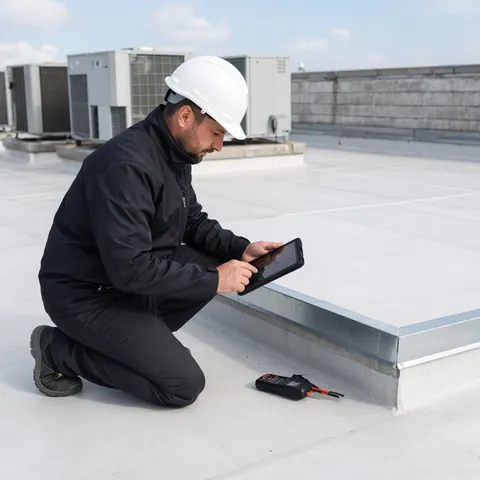
Illustrative image, not a completed project.
Where EPDM roofs fail
Seam and tape failures
Adhesive or tape seams letting go.
Shrinkage
The membrane pulling away at perimeters and penetrations.
Flashing leaks
At curbs, drains and walls.
Punctures
From foot traffic and rooftop service work.
Repair, coat or re-roof an EPDM roof?
| Option | Usually fits when |
|---|---|
| Repair | Problems are localized: clean and prime the membrane, then patch or re-seam with EPDM-compatible materials per the manufacturer's instructions. |
| Coat | The membrane is dry and sound, and a coating its manufacturer lists for EPDM, usually with a specific primer, passes an adhesion test after cleaning. Chemistry: roof coating systems. |
| Re-roof or recover | Shrinkage is widespread, the insulation is wet, or seams are failing across the roof. |
A recoat above the Title 24 size threshold counts as an alteration (below). A roof condition report tells you which option fits.
EPDM and Title 24: the black-membrane problem
On a qualifying nonresidential low-slope re-roof (more than 50% of the roof area or more than 2,000 square feet, whichever is less (Energy Code §141.0(b)2B)), the new surface needs aged solar reflectance of at least 0.63 and thermal emittance of at least 0.75, or an SRI of at least 75, with a CRRC label (§140.3(a)1A), and a re-roof over conditioned space generally needs continuous insulation (R-23 in climate zones 1–5 and 9–16, Table 141.0-C). Our Title 24 re-roof guide walks through the trigger, the cool roof values and the insulation rule.
Black EPDM falls far short of 0.63 aged reflectance, so check the CRRC listing for any specific product. A qualifying EPDM re-roof generally means one of these:
- White EPDM or a CRRC-rated coating.
- The code's U-factor tradeoff: a lower aged reflectance offset by more insulation (Table 141.0-B for alterations).
- The 25 lb per square foot exception for heavy ballast, with the weight confirmed by the designer.
- Space that isn't conditioned, which doesn't trigger the cool-roof rules.
Recoats are exempt from the insulation requirement, not from the cool-roof requirement (CEC 2025 Nonresidential Cool Roofs FAQ).
EPDM vs. TPO
| EPDM | TPO | |
|---|---|---|
| Material | Synthetic rubber | Thermoplastic |
| Seams | Adhesive or seam tape | Heat-welded |
| Usual color | Black (white available) | White |
| Repair method | Clean, prime, then tape or patch | Clean, then heat-weld a patch |
No winner across the board. On an existing EPDM roof, a repair or coating may beat replacement.
Where we work
Commercial, industrial, multifamily and HOA roofing across six Bay Area counties.
- Santa Clara County, CASan Jose, Santa Clara, Sunnyvale, Mountain View, Palo Alto, Milpitas
- San Francisco County, CASan Francisco
- San Mateo County, CARedwood City, San Mateo, South San Francisco, Burlingame, Foster City
- Alameda County, CAOakland, Fremont, Hayward, Newark, Pleasanton, Berkeley
Frequently Asked Questions
Yes, if the membrane is dry and sound. Use a coating its manufacturer lists for EPDM, usually with a specific primer, after cleaning and an adhesion test. On a nonresidential low-slope roof above the size threshold, the coating must also be a CRRC-rated cool roof product.
EPDM seams are joined with adhesive or seam tape, not heat-welded. A repair means cleaning and priming the membrane, then applying compatible seam tape or a patch per the manufacturer's instructions. If seams are failing across the roof, or the membrane has shrunk at the edges, a coating or re-roof is often the better value.
Usually not on its own for a qualifying re-roof. Nonresidential low-slope re-roofs above the threshold need aged reflectance of at least 0.63, which black membranes don't reach. Options include white EPDM, a CRRC-rated coating, the code's insulation tradeoff or the heavy-ballast exception.
Neither across the board. EPDM is a rubber membrane with taped or glued seams, usually black. TPO is a white thermoplastic with heat-welded seams, which makes it the more common choice for cool-roof re-roofs. On an existing EPDM roof, repair or coating may beat replacement.
Shrinkage. Over time, EPDM membranes can shrink and pull at perimeters, curbs and penetrations, stressing flashings and opening leaks. Small areas can be re-flashed. Widespread shrinkage is a sign to compare coating and re-roof options, so find out whether the insulation is wet before deciding.
Let's get started
Request an EPDM repair or re-roof bid
Tell us the property, the building type and what's happening on the roof. For an active leak, call.
- (408) 770-5992Calling is fastest for an active leak