
For facility managers
Commercial Roofing for Facility Managers: Roof Asset Management Without Surprises
Know what every roof needs before it becomes an emergency.
- Certificate of insurance within 24 hours of request
- Free roof condition report
- Good, better and best scopes
Roof asset management, in plain terms
Three things: an inventory of each roof (area, system, age if known, drains, equipment, warranty status), a dated condition report with photos, and repair-or-replace options for each roof, priced as good, better and best. A maintenance program keeps the reports current.
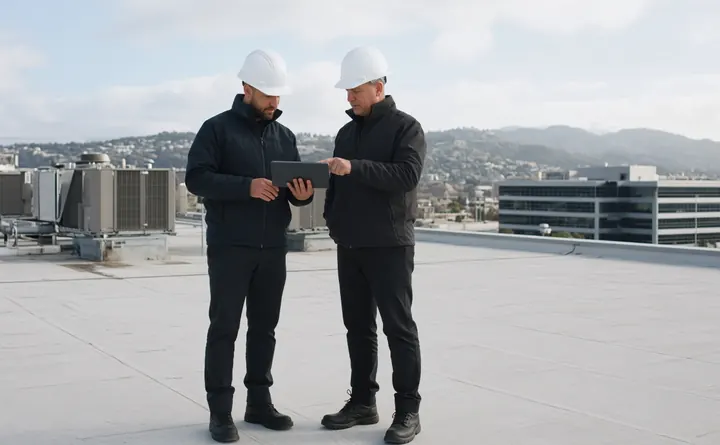
Illustrative image, not a completed project.
Finding wet insulation before you budget a re-roof
How much insulation is wet decides whether a roof can be repaired or coated or needs replacement. The standard nondestructive methods each have an ASTM standard, so you can specify them by name:
- Infrared thermography (ASTM C1153): locates wet insulation; needs suitable weather and thermal contrast.
- Electrical impedance scanning (ASTM D7954/D7954M): maps moisture under nonconductive membranes and insulation.
- Electronic leak detection (ASTM D7877): locates breaches in the membrane on suitable assemblies.
- Core cuts: confirm what the readings show.
Ask any roofer which method they'd use on your assembly, and why.
Working around rooftop equipment
Questions to settle before work starts:
- Shutdowns and restarts, coordinated with the equipment owner
- Curb heights and flashing at each unit
- Protection for walkways and service paths
- Access for mechanical and solar vendors
The Title 24 detail most FMs never hear
On a qualifying nonresidential re-roof (more than 50% of the roof area or more than 2,000 square feet, whichever is less (Energy Code §141.0(b)2B)), where rooftop equipment isn't disconnected and lifted, the insulation requirement drops to the greater of R-10 or the most insulation that still keeps the manufacturer's base-flashing height (Energy Code §141.0(b)2B exceptions; CEC 2025 Nonresidential Cool Roofs FAQ). That can change the scope and cost around large curbs. Tapered insulation at drains can count toward the average R-value, recoats don't trigger the insulation rule, and roof area over unconditioned space doesn't trigger the cool-roof rules. Our Title 24 re-roof guide walks through the trigger, the cool roof values and the insulation rule.
Safety and vendor prequalification
What the code requires of any roofing contractor
- Fall protection: Cal/OSHA's Construction Safety Orders (Title 8 §1730) require that workers on nonresidential low-slope roofs (0:12 to 4:12) be protected from falls from roofs more than 20 feet high, using warning lines and other listed methods, under the employer's Injury and Illness Prevention Program (§1509).
- Hot work: torch-applied roofing and some sheet-metal work need a fire watch during the work and for at least 30 minutes after (California Fire Code §3504.2.1). A responsible manager under your facility's hot work program can extend it. See modified bitumen and torch-down.
What to ask any roofer for in the vendor file
- CSLB license number, which you can check on cslb.ca.gov
- Certificate of insurance, and any additional-insured wording you need
- Written safety program and fall-protection plan
- Experience modification rate (EMR) and insurance limits
- Prequalification platform status, if you use one
- W-9
We send our certificate of insurance within 24 hours of request.
Protecting manufacturer warranties
Keep dated maintenance and repair records for every roof, and check whether the warranty requires manufacturer-authorized repairs before anyone works on it.
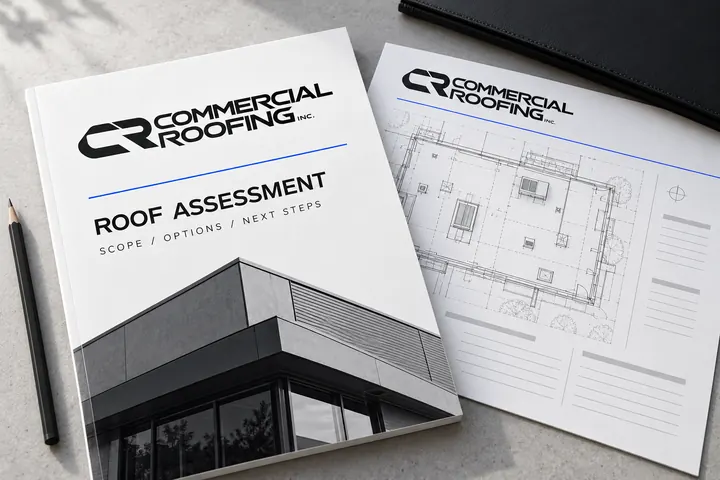
Illustrative mockup, not an issued project document.
How we work with facility teams
Written to drop into your work-order and capital-planning records.
- One point of contact
- Roof access scheduled with your team
- Photo-documented findings
- A line-item scope
- Good, better and best options
- Closeout photos
Where we work
Commercial, industrial, multifamily and HOA roofing across six Bay Area counties.
- Santa Clara County, CASan Jose, Santa Clara, Sunnyvale, Mountain View, Palo Alto, Milpitas
- San Francisco County, CASan Francisco
- San Mateo County, CARedwood City, San Mateo, South San Francisco, Burlingame, Foster City
- Alameda County, CAOakland, Fremont, Hayward, Newark, Pleasanton, Berkeley
Frequently Asked Questions
Ask how they'll coordinate shutdowns with your equipment vendor, protect curbs and service paths, and keep debris out of intakes. Get their fall-protection plan, hot-work approach, license and certificate of insurance before they go up. Ask for a written scope that shows what happens at each unit.
The common nondestructive methods have ASTM standards: infrared thermography (C1153), electrical impedance scanning (D7954) and electronic leak detection (D7877) for membrane breaches. Each works on certain assemblies and conditions, and core cuts confirm the readings. How much insulation is wet decides repair, coating or replacement.
It's reduced. On a qualifying nonresidential re-roof, where equipment isn't disconnected and lifted, the code requires the greater of R-10 or the most insulation that still keeps the manufacturer's base-flashing height. Tapered insulation at drains can count toward the average. Recoats don't trigger the insulation rule at all.
For nonresidential roofing on slopes up to 4:12, Cal/OSHA's Construction Safety Orders (Title 8 §1730) require protection from falls from roofs more than 20 feet high, using warning lines and other listed methods, plus the employer's Injury and Illness Prevention Program. Ask any contractor for their written plan.
Tell us what your prequalification platform or vendor packet needs. We send our certificate of insurance within 24 hours of request and the rest of the vendor packet on request, then schedule a free roof condition report. Call (408) 770-5992 or send your requirements.
Let's get started
Request a roof condition report or send your vendor packet
Tell us the facility, how many roofs, and what you need. Choose Facility Manager as your role. Vendor packet requirements are welcome.
- (408) 770-5992Calling is fastest for an active leak